A pencil, a little space, and somewhere interesting for your attention to go.
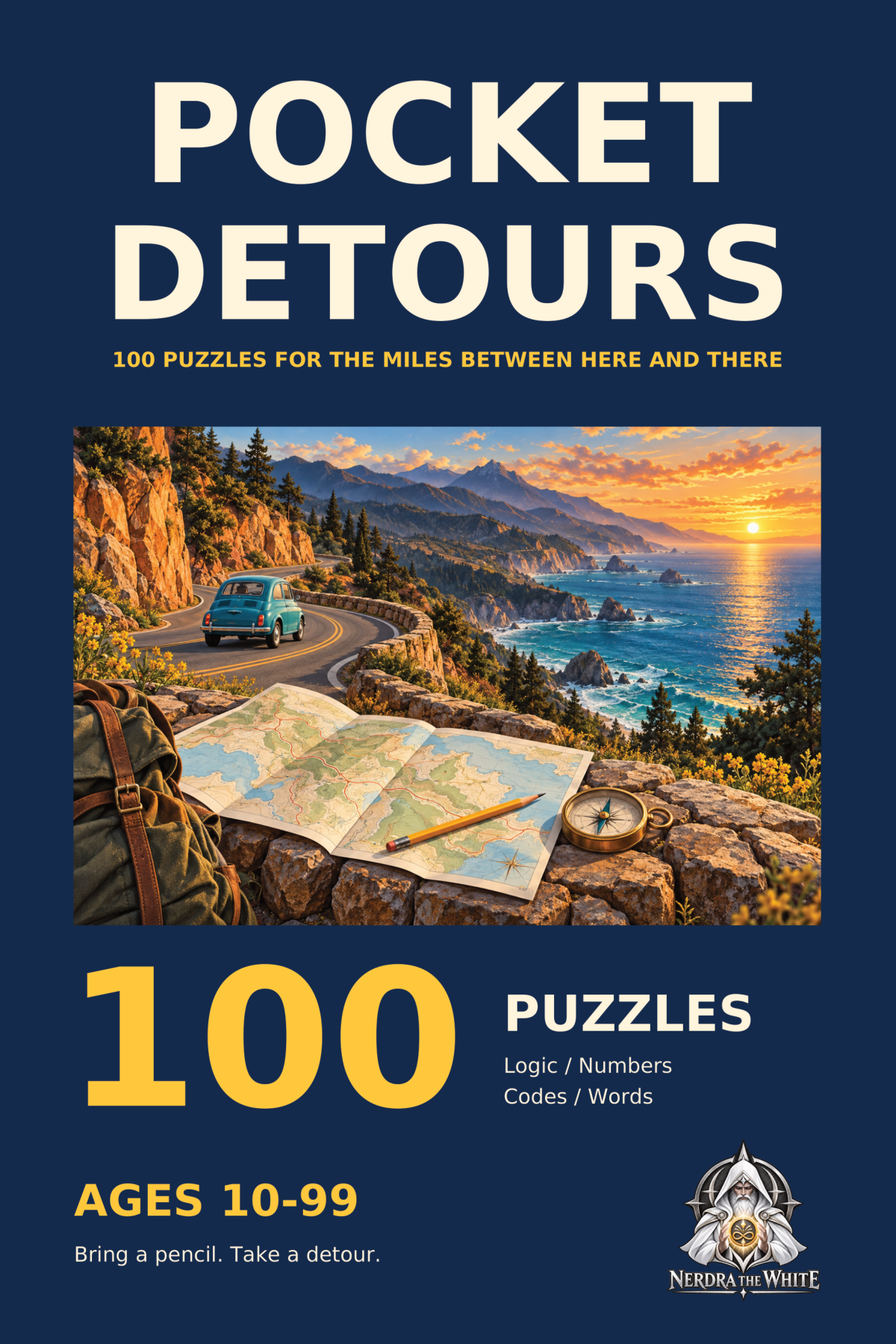
Pocket Detours contains 100 puzzles: 25 logic, 25 numbers, 25 codes and 25 words. This free companion helps you find a way into each kind, check your reasoning, and make room for a short screen break. The prepared book is a 128-page, 6 × 9-inch paperback with space to work and explanations at the back.
You can start anywhere. A half-finished puzzle is a perfectly good place to stop. Choose the kind of thinking you fancy today; return to the rest another time.
A useful starting point is the task you feel like doing, rather than a promise about how quickly you should solve it. The age range describes the intended audience; readers will find different puzzles easy or demanding.
Four ways into the book
If you feel like…
Try
Book pages
First move
Sorting clues into a clear arrangement
Logic · 001–025
5–29
Mark what is fixed.
Working with times, quantities and relationships
Numbers · 026–050
30–54
Write the units.
Following a rule to uncover a message
Codes · 051–075
55–79
Copy the rule exactly.
Playing with letter order and word structure
Words · 076–100
80–104
List the restrictions.
Keep a pencil, scrap paper and a bookmark nearby. Use the page previews to judge the print layout before choosing the paperback. Inside, the focus is short written questions with room to think and work.
02
A repeatable first five minutes
Read, mark, make one move
Read the question once for the scene and again for the instruction. Circle the thing you must produce: an order, a time, a word, or a complete matching. Underline restrictions such as “exactly,” “once,” “immediately,” or “without spaces.” Those words do real work.
Make the smallest certain move. Place a fixed item, convert a unit, decode one character, or rule out one word. A correct partial result is more useful than a confident guess. Write the reason beside it so you can find your place again.
Check, pause, return
When you have an answer, test it against the original wording. Have you used every required item? Included the stop? Kept the letters in order? Supplied the day as well as the time?
If you stall, write “I know…” and “I still need…” on the journal sheet. Change your representation once: a list can become a row of spaces; a clock calculation can become a timeline. Then choose a nudge, the explanation, or a break. There is no required timer and no penalty for looking.
03
Four kinds of puzzle. Four useful habits.
Logic
Separate facts from possibilities
Draw only the structure the question gives you: numbered seats, a sequence of stops, or a list of people and items. Put definite facts in ink-like, confident writing; mark trials with a question mark. “A must be here” and “A could be here” are different statements.
Use a fixed clue first, then connect it to a restriction. If one item occupies a position, remove that position from the others. If you test a possibility, carry it far enough to see whether it contradicts a clue. Cross out the whole trial if it fails, preserving your earlier facts. At the end, reread every clue. A tidy arrangement still has to satisfy them all.
Numbers
Let the units lead
Write the known quantities with their units. A bare 20 could mean minutes, cents or centimetres. Decide what the question asks before choosing an operation. A difference asks how far apart two values are; a total combines quantities; an equal share divides them.
Keep a short calculation trail. With time, pass through the hour or midnight in manageable steps. With lengths, convert to one unit before combining values. Estimate whether the result is plausible, then use a second check: add the change back to the cost, multiply an equal share by the number of people, or total the separate journey parts. A calculator is a personal choice if you want to focus on the setup.
Codes
Follow this puzzle’s rule
Code puzzles may look alike while using different instructions. Before decoding, write a short rule label: mirror alphabet, shift backward, alternating positions, or read by columns. Do not carry the previous puzzle’s method into the next one automatically.
Copy the coded message carefully, leaving space beneath each symbol for its partner. Decode a small portion and check it before continuing. Keep repeated letters consistent when the rule requires it. If a result looks almost like a word, resist repairing the spelling by guesswork: inspect the rule, direction and copied characters first. Where the transformation is reversible, encode your answer again and compare it with the original message.
Words
Count what is actually there
Turn the instruction into a short checklist: number of letters, permitted choices, repeated letters, order and meaning. Some tasks ask you to change one position; others ask you to rearrange all the supplied letters. Those are different operations.
For an arrangement, tick off each available letter as you use it, including duplicates. For a ladder, compare neighbouring words position by position. For a selection puzzle, test every condition before accepting a plausible-looking choice. If reading or spelling makes a puzzle less enjoyable, work aloud with a partner who reads the exact text, or switch categories. A preference is useful information about what to try next.
04
Try first. Reveal when ready.
The four questions below come directly from the 100-puzzle book. Each has a separate optional nudge and a closed answer reveal. Skip this section if you want to meet every puzzle fresh. Only open the solution you want to see.
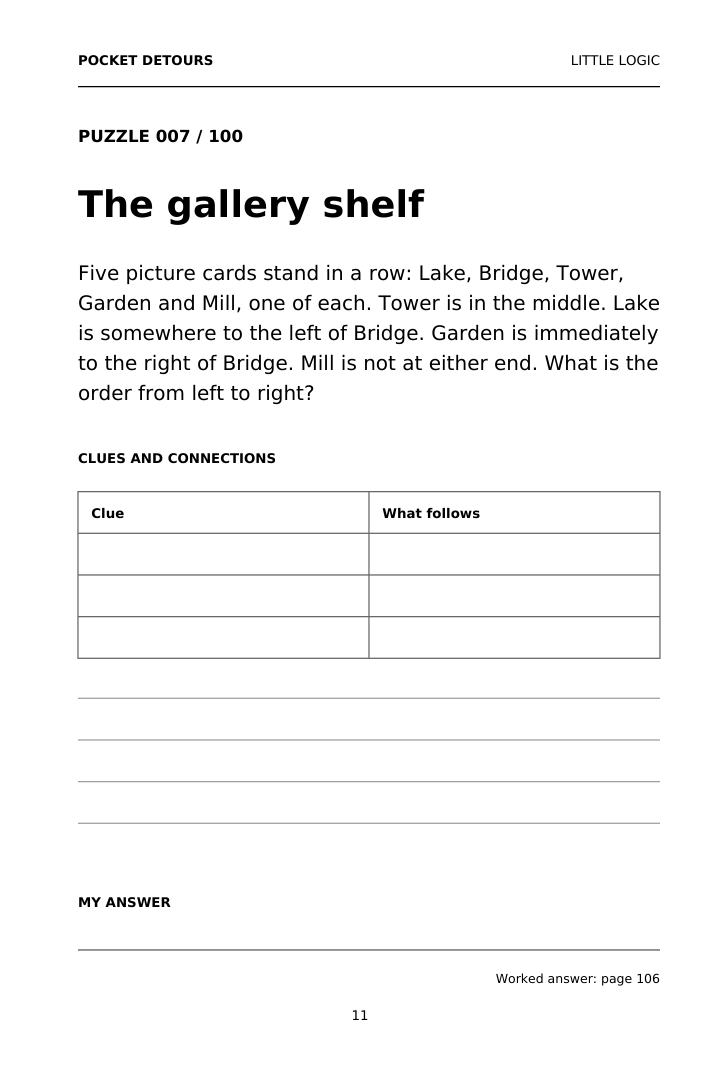
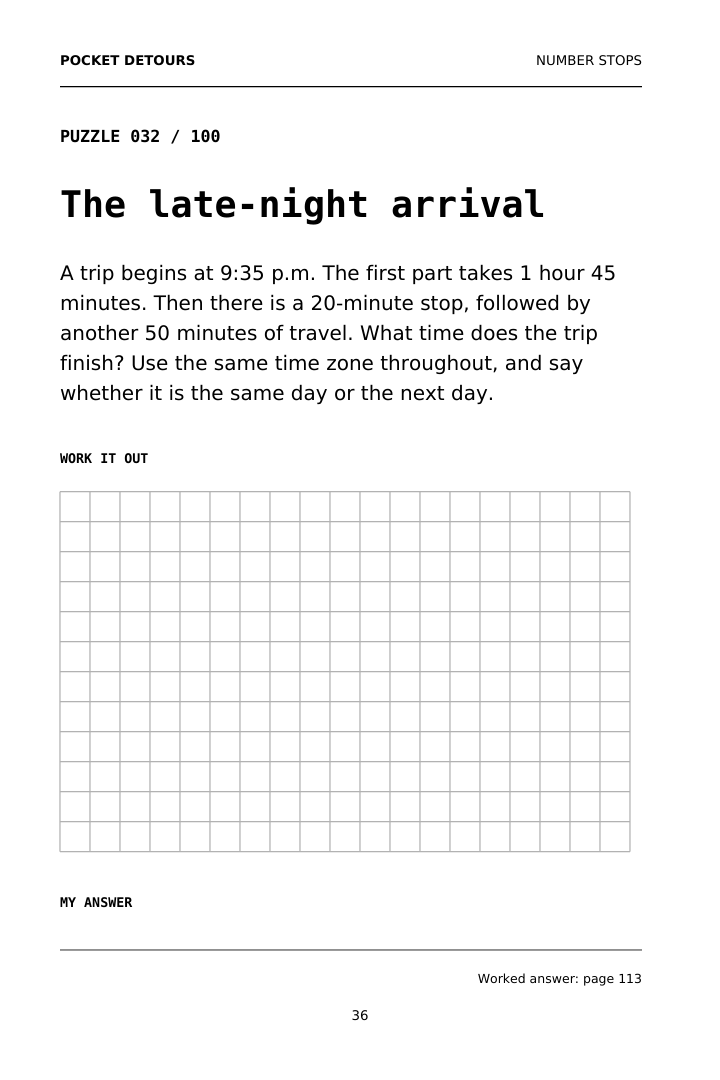
Logic · actual page 11Numbers · actual page 36
Worked example · logic · Puzzle 007 · Book page 11
The gallery shelf
Five picture cards stand in a row: Lake, Bridge, Tower, Garden and Mill, one of each. Tower is in the middle. Lake is somewhere to the left of Bridge. Garden is immediately to the right of Bridge. Mill is not at either end. What is the order from left to right?
Try it first on paper. The hint and solution stay closed until you choose them.
Show one nudge for puzzle 007
Put the fixed middle card in place. Treat Bridge and Garden as a pair that must stay together.
Reveal answer and worked steps for puzzle 007 — spoiler
Book answer:Lake, Mill, Tower, Bridge, Garden.
Number five positions from left to right. Tower is fixed in position 3.
Bridge–Garden can occupy 1–2 or 4–5. Neither 2–3 nor 3–4 works because Tower already occupies 3.
The pair cannot take 1–2: Lake needs a position before Bridge. Therefore Bridge takes 4 and Garden takes 5.
Only 1 and 2 remain. Mill cannot be at an end, so Mill takes 2 and Lake takes 1. Read every clue again against the completed row.
Carry this forward: A pair can be a useful working unit. Keep “somewhere left” separate from “immediately right.”
The book’s answer and explanation appear on page 106.
Worked example · numbers · Puzzle 032 · Book page 36
The late-night arrival
A trip begins at 9:35 p.m. The first part takes 1 hour 45 minutes. Then there is a 20-minute stop, followed by another 50 minutes of travel. What time does the trip finish? Use the same time zone throughout, and say whether it is the same day or the next day.
Try it first on paper. The hint and solution stay closed until you choose them.
Show one nudge for puzzle 032
Work through the three parts in order. Write a new clock time after each part, and watch for midnight.
Reveal answer and worked steps for puzzle 032 — spoiler
Book answer:12:30 a.m. the next day.
From 9:35 p.m., add one hour to reach 10:35 p.m., then 45 minutes to reach 11:20 p.m.
Include the stop: 20 minutes takes the clock to 11:40 p.m.
Split the final 50 minutes into 20 minutes to midnight and 30 minutes after it. The date changes at midnight.
Check another way: the whole trip lasts 105 + 20 + 50 = 175 minutes, or 2 hours 55 minutes. Adding that to 9:35 p.m. gives the same arrival.
Carry this forward: Time calculations need both a clock reading and, when requested, the correct day.
The book’s answer and explanation appear on page 113.
Worked example · codes · Puzzle 057 · Book page 61
The mirror-alphabet invitation
A message uses the alphabet as a mirror: A becomes Z, B becomes Y, C becomes X, and so on. To decode, replace each letter with its mirror partner. Decode KRXMRX.
Try it first on paper. The hint and solution stay closed until you choose them.
Show one nudge for puzzle 057
Write A through Z above Z through A. Match each encoded letter to the letter directly below it.
Reveal answer and worked steps for puzzle 057 — spoiler
Book answer:PICNIC
The rule is a mirror pairing, not a one-place shift. Start with the printed letters K, R, X, M, R, X.
Read each mirror partner: K → P; R → I; X → C; M → N; R → I; X → C.
Keep the original order. The six output letters form the answer.
Check by mirroring the decoded letters again: P → K, I → R, C → X, N → M, I → R, C → X. This restores KRXMRX.
Carry this forward: Repeated input letters must receive the same output under this rule. A reverse check can catch a copying slip.
The book’s answer and explanation appear on page 119.
Worked example · words · Puzzle 082 · Book page 86
Seven letters, no repeats
Choose the only seven-letter word in this list that uses every letter at most once: CAMPING, BALLOON, LOOKOUT, COTTAGE. Count repeated letters even when they are separated.
Try it first on paper. The hint and solution stay closed until you choose them.
Show one nudge for puzzle 082
Test the letters in each word, including repeats that are not next to one another.
Reveal answer and worked steps for puzzle 082 — spoiler
Book answer:CAMPING
All four choices have seven letters, so length alone does not distinguish them.
CAMPING contains C, A, M, P, I, N and G: seven different letters.
BALLOON repeats L and O. LOOKOUT repeats O, including letters separated by K. COTTAGE repeats T.
Only one choice passes both requirements: seven letters and no repeated letter.
Carry this forward: Apply every part of a word rule. Familiarity with the word is useful, but the printed letters decide this puzzle.
The book’s answer and explanation appear on page 124.
05
Seven small screen breaks
Use this as a menu across a week, not a streak to protect. Each day can be a few minutes, one puzzle, or one useful observation. Repeat a day or leave a gap whenever it suits you.
Day 1 · Find a comfortable start. Pick any category. Read one question and identify the requested answer. Stop there if you like.
Day 2 · Notice the wording. Try logic. Circle one restrictive word and write what it rules out.
Day 3 · Show the working. Try numbers. Include units on every line and check the final result another way.
Day 4 · Follow the instructions. Try a code. Write its rule at the top of your working before decoding.
Day 5 · Inspect the letters. Try words. Tick off each condition when your answer meets it.
Day 6 · Share one clue. Solve together. Let one person read and another record; swap roles after the first useful deduction.
Day 7 · Return with fresh eyes. Revisit a paused puzzle. Note the move that helped, then choose a favourite category for next week.
Keep the book where a pause naturally happens: beside a chair, in a travel bag, or on a table at a stop. During a journey, puzzles are for passengers or for when you are safely parked. The aim is a pleasant activity. Choose a pace and stopping point that suit you.
06
Make the desk yours
Use extra paper when the working space feels small. Enlarge this companion in your browser, read a question aloud, or ask a partner to write while you explain. The broad ages 10–99 label does not mean one difficulty or print size suits everyone; check the actual interior pages for your needs.
For a pair or small club, agree before starting whether hints are welcome. Ask “Would you like a question, a nudge, or the answer?” instead of announcing a solution. Give everyone thinking time and let anyone pass. Share the step that helped you, rather than comparing finishing times.
The three sheets below give you a place to save a stopping point, choose a hint, and run a friendly session. They are free companions to the book. You do not need to finish or submit them. Keep them on paper or use the fields while this page is open; print or copy anything you want to retain.
Use these fields on screen or print the sheets. Nothing is submitted. Entries may disappear when you leave or reload the page; print or copy your notes to keep them. Closed example answers stay closed when printing. Open an example first if you want it on your printout.
A
Pause & return
The solver’s journal
Capture one puzzle, including unfinished work. “Paused” is a useful result: a written next step makes it easier to come back.
Completed example: puzzle 032 — contains the answer
Puzzle / page
032, The late-night arrival / 36.
What is asked?
A finishing time, and whether it is the same or next day.
Known facts / working
Start 9:35 p.m. → first part ends 11:20 p.m. → stop ends 11:40 p.m.
Next useful step
Split the final 50 minutes at midnight.
Result / check
12:30 a.m. the next day. Check: 105 + 20 + 50 = 175 minutes, or 2 hours 55 minutes.
What helped?
Writing each clock time kept the stop from disappearing.
B
Keep the discovery
Choose a hint, one step at a time
Start at the level you want. With a partner, agree on the level before they help. A nudge should unlock one move without announcing the whole answer.
Completed example · no answer revealed. Puzzle 007, “The gallery shelf.” Stuck point: I have not organised the clues. Chosen help: a question. Partner prompt: “Which card has a fixed position?” My next move: number five spaces and mark the fixed card. Stop rule: try the rest myself before asking for another hint.
C
Two readers or a small club · Ages 10–99
A friendly puzzle session
Choose a reader, a note-taker and, if useful, an answer keeper. One person can fill several roles. Swap roles between puzzles and let anyone pass or work alone.
Completed example · flexible 20-minute session. Choose puzzles 032 and 057. Spend 2 minutes reading the first question, 6 minutes exploring, 2 minutes comparing methods, 6 minutes on the second puzzle, and 4 minutes sharing a useful step. Mira reads, Lee records; swap for the code. Hints only when requested. Use a larger sheet for working and stop on time even if unfinished.
Free sample puzzles, interior previews and three companion sheets are available now. The 100-puzzle, 128-page paperback has been submitted to KDP review and cannot be ordered here until Amazon approves the listing and the live order page is verified. No preorder or payment is collected.
A few useful answers
What is in Pocket Detours?
100 puzzles in four equal sections: logic, numbers, codes and words. The paperback has 128 pages at 6 × 9 inches, including working space and answers with explanations.
Who is it for?
The intended audience is ages 10–99. Familiarity with different puzzle types varies, so browse the actual interior pages to judge the fit. The age range is not a guarantee that every puzzle or print size suits every reader.
Do I have to solve the puzzles in order?
No. Pick a category you enjoy, switch when you want a change, and leave a note when you pause.
Will the companion spoil the book?
Four exact book questions are included as worked examples. Each hint and solution stays closed until you choose to open it. Hints and answers stay closed until you choose to reveal them.
Does the guide cost extra?
No. This guide and its three worksheets are free companions. The paperback is the only separate book purchase described here.
Can I use it with a partner or club?
Yes. Read the exact question together, agree before giving hints, swap reader and note-taker roles, and let each person choose whether to share an answer.
Where do I get delivery or order help?
For a paperback bought from Amazon, use the Amazon order record and customer service options for that purchase. Payment, delivery estimates and order support stay with the merchant. The free companion has no checkout.
Pass the good find along.
Choose a little detour: logic, numbers, codes or words. Try the free Pocket Detours samples for ages 10–99.